
Sanford Previous Resident Sources
No single roll supplies a full list of prior occupants. Sanford previous residents appear in overlapping records that were made for tax, title, census, news, or directory purposes. Begin with the era closest to the question. Recent work starts with the Seminole County parcel card and deed chain. A search in the early twentieth century leans more heavily on the Sanford Museum, the Polk street section, tax rolls, and public census schedules.
| Source | Years It Covers | Where Held | What It Shows |
|---|---|---|---|
| Seminole Official Records | 1913 to present | Clerk, DuProcess, Records Center | Title chain, parties, legal description |
| Orange County predecessor records | Before 1913 | Orange Clerk and State Archives | Earlier Sanford land chain |
| Polk street and name directories | 1917-18 verified; more Museum volumes | Sanford Museum and UCF | Occupants, spouses, work, street neighbors |
| Sanford city tax rolls | 1920-1966 | Sanford Museum | Taxpayer, owner, and value |
| Federal census | Through 1950 now public | NARA and genealogy access | Enumerated household and location |
| Sanford Herald | 1908-2000 microfilm | Sanford Museum | Obituaries, sales, and social context |
| Sanborn fire map | 1887 verified | Library of Congress | Structure, use, material, and street labels |
Owners, taxpayers, directory occupants, and census households can be different people. Keep those roles in separate columns. A matching mailing and situs address plus homestead may support owner occupancy for one assessment year, but it still does not identify everyone in the home. For the older collections and their exact reading rules, use the Sanford city directory material rather than treating a title holder as the whole household.
Start Sanford History by Parcel
The Seminole County Property Appraiser accepts a full address, street, owner, parcel number, subdivision, or facility. Copy the parcel ID, situs address, mailing address, legal description, subdivision, lot and block, exemption clues, and latest sale reference. Situs means the physical location. The mailing line is where the tax notice goes, which may be far from Sanford.
Open the appraisal map and confirm that the selected polygon fronts the expected road. Corner parcels and multiunit sites can produce misleading address matches. The legal description is more durable than a street number and is the key used to test whether two deeds concern the same land.
Sales rows can offer a fast bridge to the newest deed, but they should be copied as clues, not conclusions. Preserve the sale date, deed type, price field, and book-page or instrument reference. Then verify the actual instrument. A sale row and a recording can reflect different dates, and neither establishes when a family entered or left the house.
Sanford permits and code cases can add work dates, applicants, contractors, inspections, and completion evidence. Query Citizenserve by address or parcel where the public module permits. If an older file is absent, send the City Clerk a focused Chapter 119 request for the permit number, site address, date range, application, inspections, and certificate of occupancy. Ask for an electronic copy and a cost estimate before extensive work.
Note: A parcel card describes an assessment roll and is not a title opinion or a list of all past residents.
Walk Sanford Deeds Backward
The Seminole Official Records search indexes deeds by party and legal description. The Clerk says its Official Record Books date to 1913 and that all Official Records should now be online. The guide begins its date example at 1983, so ask Land Records to confirm older image or index coverage instead of assuming an online cutoff.
- Pull the current titled owner, legal description, parcel number, and latest sale clue from SCPA.
- Search that owner as grantee, the receiving party, near the sale date. Match the full legal description.
- Record the grantor, instrument number, book and page, recording date, and deed type.
- Search that grantor as an earlier grantee. Try every spelling variation, as the Clerk recommends.
- Repeat until the chain reaches 1913, then check Orange County predecessor books and archival catalogs.
- Grantor and grantee
- The grantor gives or sells an interest; the grantee receives it.
- Chain of title
- The linked sequence of transfers for the same land.
- Legal description
- The lot, block, subdivision, metes-and-bounds, or other formal land identity that survives address changes.
A recording date is not a move date. Quitclaim, corrective, trustee, or family transfers may not mark a household change. The deed index is a locator; the image contains the fuller transfer terms. For certified paper copies or an unavailable image, contact Land Records at 407-665-4405 or the Records Center at 1750 E. Lake Mary Boulevard.
Sanford Records Cross County Lines
Seminole County was created from Orange County in 1913, with Sanford as its county seat. That date is a records boundary, not just local history. A deed, court matter, or civil record made before the cutover may be filed under Orange County even when the property sits in modern Sanford.
Search the Orange County predecessor series when the Seminole chain stops at its first books. The State Archives of Florida can help locate county and state record groups. Mellonville, annexed into Sanford in 1883, is another name worth checking in nineteenth-century catalogs and maps.
Map Sanford Homes Before 1913
The 1887 Sanford Sanborn map has only two sheets, so a researcher can inspect the whole mapped town. It shows building footprints, materials, uses, and period street labels. A footprint can prove that a structure stood at a place, but it does not name a resident.
Federal litigation is a secondary trail, not a house roll. The PACER case locator may connect a known person or company to a dated filing, while the land identity must still be proved through county deeds.
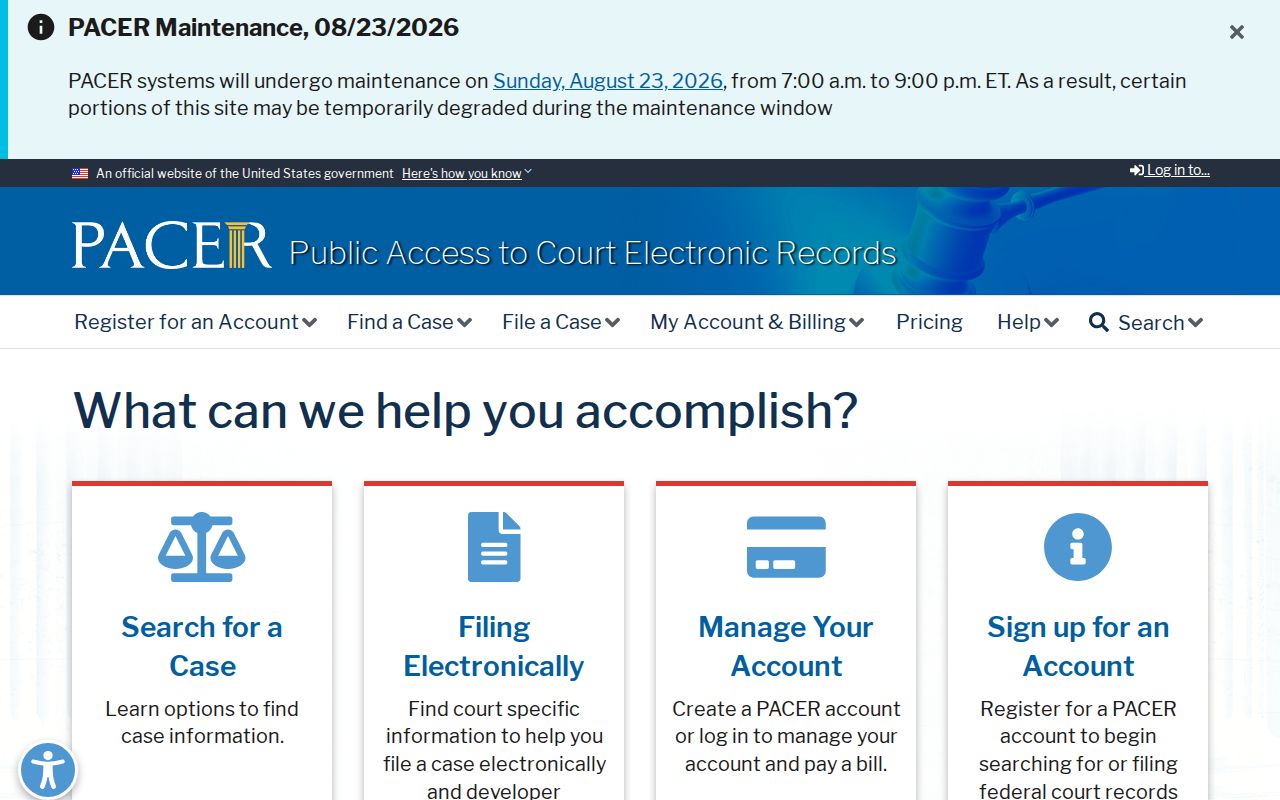
The access page shows the separate federal route. Keep any party role, court, case number, and filing date attached to the result.
The Museum's city tax rolls from 1920 through 1966 form a strong bridge between title and occupancy sources. They preserve taxpayer and value evidence even when no directory issue is at hand. Ask Museum staff with an exact street, name, and year range.
Pair Sanford Directories and Census
The 1917-18 Polk volume has both an alphabetical list and a street section. The street side reverses the search: street, house number, then occupant or business. Pair it with the nearest public census, then keep the directory name, spouse, occupation, and address exactly as printed.
- Browse the period street section for the address and record every named occupant.
- Check the alphabetical entry for spouse, occupation, and abbreviation clues.
- Compare the nearest 1920, 1930, 1940, or 1950 census household.
- Use the city tax roll to separate taxpayer or owner from directory occupant.
- Move one directory issue at a time to spot arrivals, departures, and address changes.
An apparent move may instead be a missed canvass, a skipped volume, or a number change. No verified citywide Sanford renumbering year was found, so use plats, deeds, Sanborn sheets, and legal descriptions rather than guessing.
Lawful use. Research Sanford previous residents for house history, genealogy, heirs, or personal curiosity. Never use a record trail to watch, harass, or harm a living person.
Close Sanford Trails With Life Records
A death date or marriage can distinguish two people with the same name and lead to probate or an estate deed. Florida access rules vary by record. Births less than 125 years old are confidential. Cause of death is confidential for 50 years, while marriage certificates are public. Adoption records remain confidential.
The Florida birth certificate page explains eligibility and order channels.
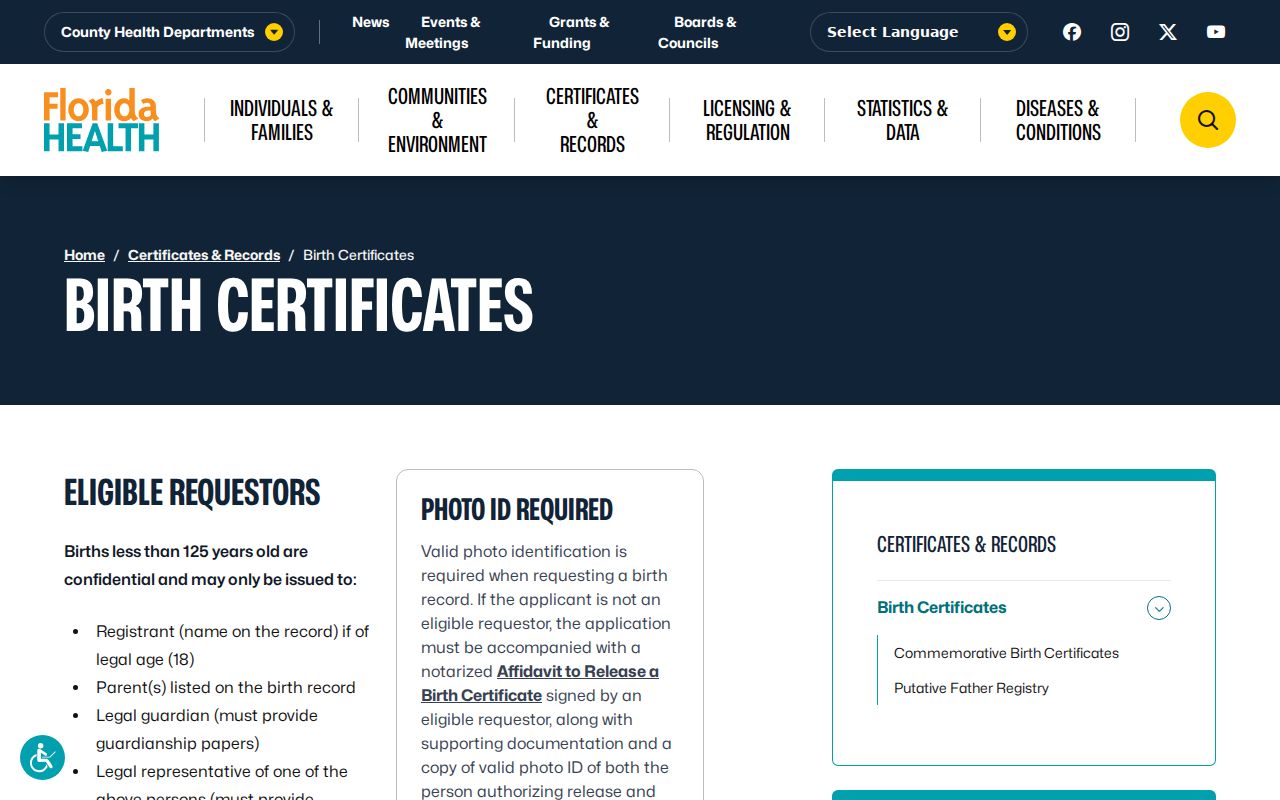
The screen reinforces that a birth search is an eligibility-based request, not an open address directory.
For a spouse or date clue, consult the Florida marriage certificate service.
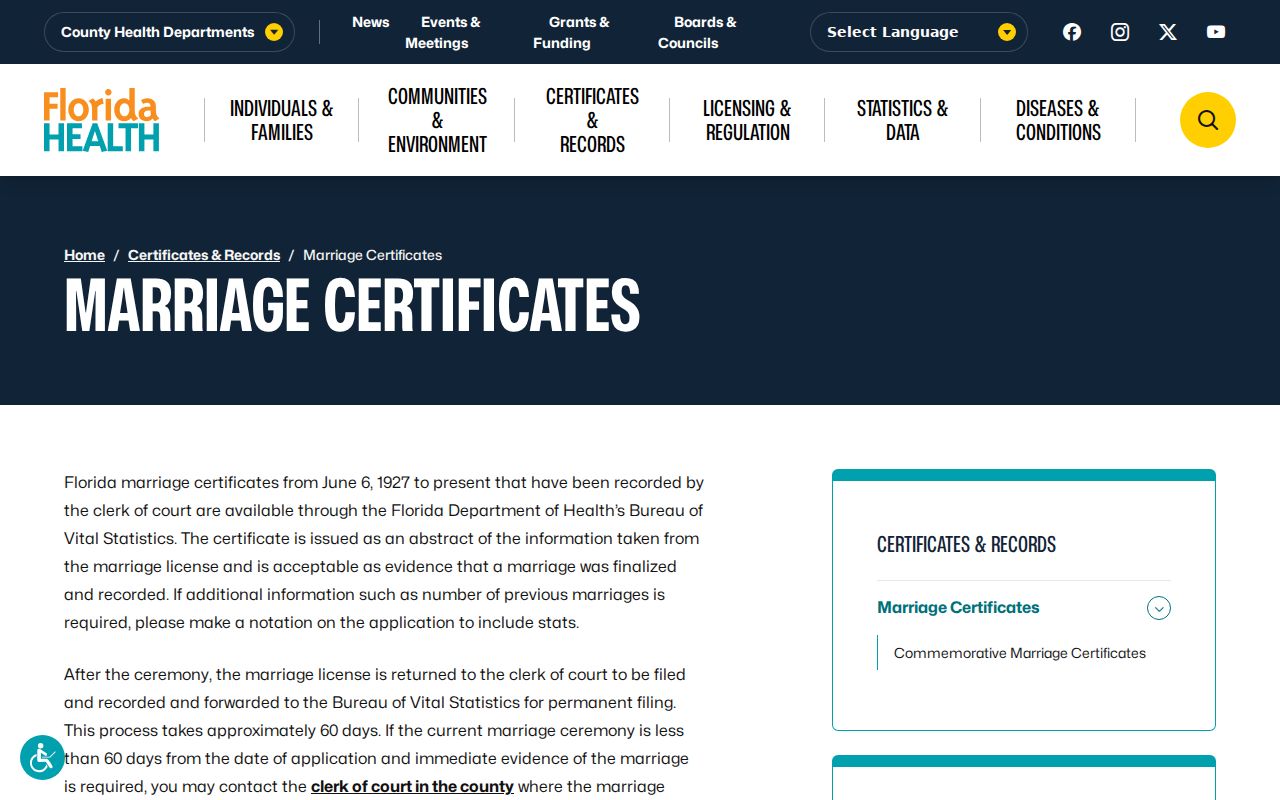
A state marriage certificate is an abstract from a license. The local Clerk record may hold fuller details.
The Florida death certificate page sets out ordering routes and the cause-of-death restriction.
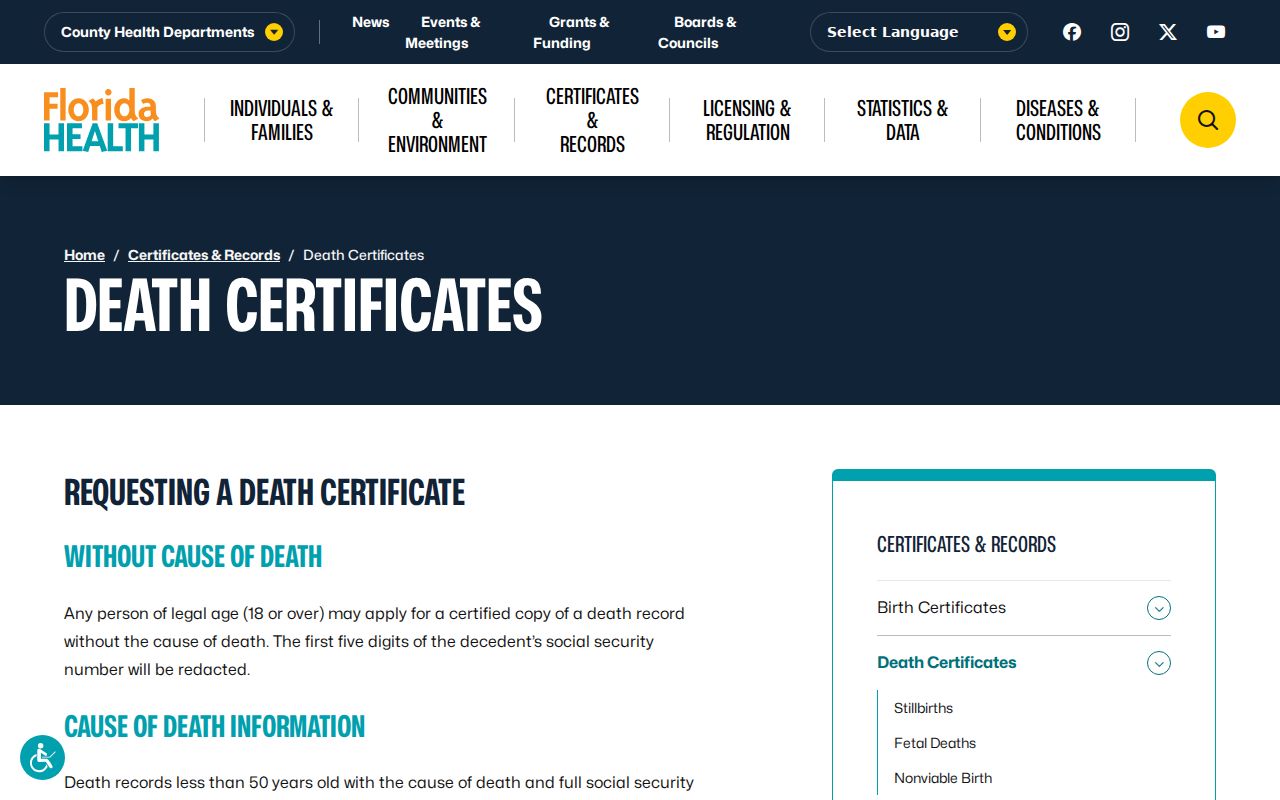
Join a confirmed death date to Sanford Herald microfilm, a probate case, and any estate deed without treating an obituary alone as title proof.
Ask Sanford Museum by Address
The Sanford Museum combines a city archive, research library, and newspaper microfilm at one local desk. Its holdings include Polk directories, telephone books, maps, family histories, school annuals, tax rolls, and Sanford Herald film. For a focused request, give staff the exact street number, all known forms of the street name, one or more surnames, and a narrow year range.
Ask which directory, telephone book, tax roll, newspaper reel, or annual covers the target period. The Museum's web page does not enumerate every Polk or telephone-book year, so staff confirmation is better than publishing a guessed run. The desk is at 520 E. First Street, phone 407-688-5198, and operates Tuesday through Saturday, 9 a.m. to 5 p.m.
This local fallback matters when optical text search fails, when an issue was never digitized, or when a street abbreviation differs. It also keeps missing evidence visible. A blank year should remain a gap until another contemporary source resolves it.