
Sanford Directory Collections by Year
Sanford's historical directory shelf is unusually strong for a city its size. One R. L. Polk city directory is fully verified online, while the Sanford Museum reports a broad Polk shelf without listing every year. The Museum also keeps sources that test and extend directory entries. Contact the curator before describing secondary catalog years as a complete run.
| Sanford collection | Years | Where held | Access |
|---|---|---|---|
| R. L. Polk city directory | 1917–18 verified | UCF STARS and Sanford Museum | Free digital view or Museum copy |
| Broader Polk shelf | Museum reports an almost complete historical shelf; exact run not posted | Sanford Museum | Visit, phone, or curator contact |
| Local telephone books | Years not itemized online | Sanford Museum | Onsite or staff-assisted research |
| City tax rolls | 1920–1966 | Sanford Museum | Research visit or staff contact |
| Sanford Herald microfilm | 1908–2000 | Sanford Museum | Onsite microfilm |
| Federal census | Public schedules through 1950 | NARA and genealogy databases | Name and household research |
Secondary catalogs identify individual Polk years such as 1909, 1911, 1920, 1924, 1926, and several mid-century issues. Those leads are useful when contacting staff, but the Museum's official page does not enumerate the final printed year or every gap.
Open Sanford's Digitized Directory
The UCF STARS catalog hosts the 1917–18 Sanford City Directory, digitized in 2011 from Sanford Museum holdings using 400-dpi masters. This is more than an alphabetical name list. The volume includes a street directory, abbreviations, city and county government, churches, schools, clubs, labor groups, secret societies, classified businesses, and Seminole County business entries.
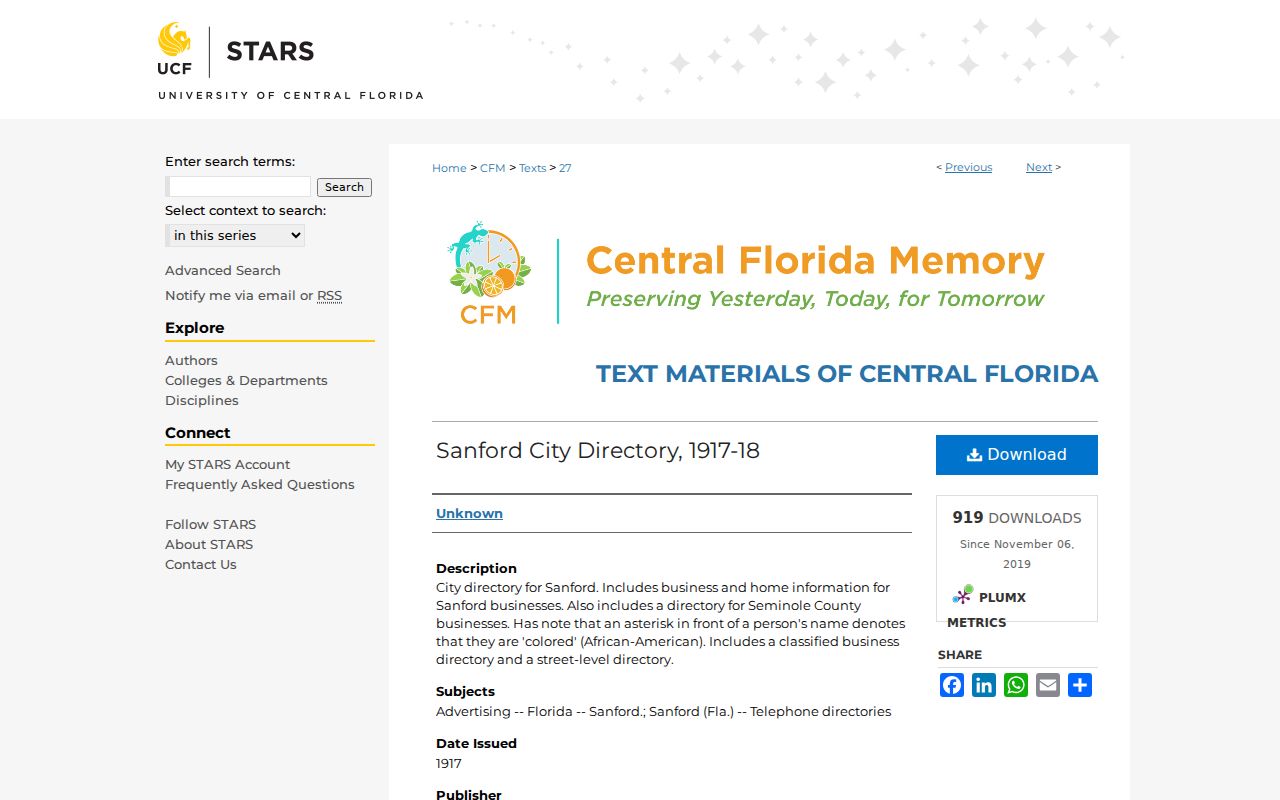
The capture points to the free digital copy, which can be searched by page and browsed when optical text misses a name or abbreviation.
The alphabetical names begin around page 43, the street section around page 23, and classified businesses around page 123. Its county portion can follow a person or firm between Sanford and places such as Lake Mary, Oviedo, Geneva, or Longwood without changing books.
Read a Sanford Directory Entry
A city directory entry compresses identity, work, family, and address into a short line. Transcribe it exactly before expanding any code. The 1917–18 volume's own abbreviation key controls the meaning, and a symbol borrowed from a different city's book may be wrong.
| Name | Surname, given name, and often an initial; spouse may follow in parentheses |
|---|---|
| Work | Occupation or employer, often shortened |
| Residence | House number and street; “r” generally means resides, “h” house or home, and “bds” boards |
| Status clue | A widow notation or spouse name can separate people with the same name |
| Affiliation | Government, church, school, club, labor, and institutional lists add context |
The directory description says an asterisk marked a person with a racial designation used by that publisher. Treat it as period indexing language that reflects the book's era and bias, not as a modern description of the person.
- Criss-cross directory
- A street-first section arranged by road and house number rather than surname.
- Householder index
- An address-order list used to locate the name printed for a household at that time.
- Abbreviation key
- The volume's own legend for short forms used in names, work, marital status, and addresses.
Research Sanford Directories at Museum
The Sanford Museum is a city archive, research library, newspaper room, and local collection in one place. It stands at 520 E. First Street and is open Tuesday through Saturday, 9 a.m. to 5 p.m. Call 407-688-5198 with a name, street, and target year window so staff can identify the right Polk book, telephone book, tax roll, newspaper reel, annual, or family file.
The Museum's research collections page is the official inventory to check before a visit. It also lists photographs, maps, letters, genealogies, memoirs, subject files, and Seminole High School annuals.
A city directory gap may be filled by the 1920–1966 tax-roll series or Sanford Herald microfilm. A tax roll identifies the taxpayer or owner rather than every occupant. Newspaper notices can add an event, relative, or business tie, but should be searched around a narrow date from another record.
Sanford History Beyond Directory Shelves
The Sanford Historical Society supports oral histories, programs, and Museum preservation. It does not advertise a public membership directory of Sanford residents. Its collection overview is still useful for understanding which local materials exist and where a historical question should go.
Visit the Sanford Historical Society overview for that local context.
The Society's role complements the municipal archive without replacing the Museum's staff-assisted city directory search.
Trace Sanford Families Across Directories
Follow one household one issue at a time. A city directory can show an arrival, move, spouse, widow notation, or shift in occupation between decennial census years. It can also omit a person because the canvass missed them, they declined a listing, or no volume was issued or preserved.
- Start with a firm name, address, or census year. Search the closest directory and copy the full entry plus its abbreviation key.
- Move to the prior and next available issues. Record every spelling, spouse, occupation, and street change without merging names too early.
- Flip to the street-order section. Compare occupants at the address and nearby numbers, while allowing for changes in numbering or canvass coverage.
- Pair the 1920, 1930, 1940, or 1950 directory era with the corresponding public census household and the Museum's city tax roll.
- Use Herald microfilm, probate, obituaries, or yearbooks to test a departure, death, heir relationship, or classmate connection.
Owners, taxpayers, directory occupants, and enumerated census households may be different. Keep four columns for those roles rather than forcing all sources into one household statement.
Sanford Directory Timeline and Boundaries
Place each entry in Sanford's changing civic geography. The place grew from Fort Mellon and Mellonville, incorporated in 1877, and annexed Mellonville in 1883. Seminole County was created from Orange County in 1913, so earlier court and land records may sit under Orange County even when a later directory says Sanford.
| 1887 | Sanford Sanborn map records a two-sheet view of the early city. |
|---|---|
| 1908 | The Museum's Sanford Herald microfilm run begins. |
| 1913 | Seminole County is created from Orange County, with Sanford as county seat. |
| 1917–18 | The verified Polk city directory prints alphabetical, institutional, business, and street sections. |
| 1920–1966 | Sanford city tax rolls provide a second local property series. |
| 2011 | UCF digitally reproduces the Museum's 1917–18 Polk volume. |
Those cutovers explain why one researcher may need a directory, an Orange County deed, a Seminole County record, and a city tax roll for a single long Sanford timeline.
Find Sanford Classmates and Veterans
Sanford Museum annuals and the Naval Air Station Sanford collection create lawful ways to reconnect with former classmates and military friends. The NAS files cover the 1940s through 1960s through base newspapers, cruise books, biographies, and memoirs. A person posted briefly to Sanford may appear there even if a civilian directory canvass missed them.
Seminole High School annuals can confirm a student or faculty link, while church, school, labor, club, and fraternal lists in the 1917–18 directory can distinguish same-name residents. These sources show historical affiliation only. They should not be used to infer current private membership.
Extend Sanford Research to Archives
When the local shelf ends, search the State Archives catalog under Sanford, Seminole County, and Orange County. Many originals or unindexed boxes require staff help or an in-person visit, so the catalog is a finding aid rather than a promise of an online name image.
The State Archives of Florida page explains catalog and research access.
The state route is especially valuable for pre-1913 predecessor records and transferred local-government series that do not appear in the Sanford city directory shelf.